
What Is Caregiver Burnout? How to Recognize It and Support Your Nervous System

Caregiver burnout often builds when chronic caregiver stress outpaces support, rest, and nervous system regulation.
Caregiver Burnout: What It Is and Why It Happens
Any parent who is reading this probably just said something to the effect of “I absolutely know how that feels.” Parents are burnt out. Daycare providers struggle. And don’t even get me started on the sandwich generation (you know, those who are raising kids and taking care of their ailing parents at the same time).
Trust me, as a therapist who cares emotionally for people and then comes home to a husband and two kids who also need my time and attention – I get it on a spiritual level.
I don’t think I have to do much convincing around the idea that we are burnt out. However, I would like to chat about how it is impacting our mind and body (nervous system), and what we could possibly do about it to make it better. Caregiver burnout often builds when chronic caregiver stress outpaces support, rest, and nervous system regulation.
For a helpful overview of caregiver stress and burnout warning signs, the National Institute on Aging offers guidance on recognizing caregiver strain.
Caregiver Burnout Symptoms: What’s Happening Mentally?
Brain Fog
Quite frankly, there is too much going on mentally. One of the biggest signs of burnout is the mental fog associated with having so much going on in the mind that it becomes hard to think at all. It actually becomes paralyzing.
Here’s some signs that you might have brain fog:
Difficulty making decisions
Feeling like your processing speed is really slow
Getting overwhelmed easily by tasks
Decision Fatigue
When you’re juggling needs all day, decision fatigue can make even small choices feel huge. This is another common caregiver burnout symptom.
The emotional toll that taking care of somebody all of the time can have on a person’s brain and emotions are significant. There is definitely something to say for having to watch your emotions all day in order to be able to appropriately respond to somebody else and attune to their needs.
Common feelings of somebody who is experiencing caregiver burnout are:
Agitation
Anger
Emotional numbness
Sadness/grief over how life was
Demand Sensitivity
I want to talk for a second about demand sensitivity. Demand sensitivity is, in essence, the magnification of the thought of what other people want from you. It isn’t necessarily just people pleasing, but feeling overwhelmed by trying to meet needs in the right way, the right time, without falling short of people’s expectations.
For people who struggle with demand sensitivity, caregiving can be extremely difficult and soul-draining. It is important to work on this in trauma therapy in order to release some of the internal stressors that are driving the burnout.
If you’re curious about how stress responses affect the body, Harvard Health has a practical overview of stress and the body.
How Caregiver Burnout Affects the Body and Nervous System
Caregiver burnout is a physical experience. It can literally be a physical experience (long days on your feet, physically lifting another person, doing tasks for them that they can’t, etc.). Also, the mind does not live separate from the body, and therefore emotions impact your physiology.
Because burnout is characterized by lack of interest in the task, feeling unappreciated or ineffective, and emotional and physical exhaustion, burnout lives more in the parasympathetic part of the nervous system. More specifically, the dorsal vagal part of the sympathetic nervous system. This part of the nervous system comes online when there has been too much sympathetic (think fight or flight) for too long, and therefore a disassociation, freeze, or collapse happens to compensate for it.
Here are some possible physical manifestations of caregiver burnout:
Exhaustion
Feeling heavy
Sense of disconnect from your body
Chronic, unexplained pain
Headaches
Disruptions in digestion and therefore appetite
I think it is important to mention the impact that this chronic stress has on the immune system. (Long story short, stress hormones impact the body’s ability to produce immune cell production.) Those who have kids and are being impacted by caregiver burnout find themselves sick a lot. Yes, kids are petri dishes for fun viruses, and a system that has a lot of stress on it has little energy left to fight these illnesses off. That’s why it is important to not only take care of yourself but also not to blame yourself for getting sick as often as you might be.
For more on how chronic stress affects health, the American Psychological Association has evidence-based resources on stress and physical wellbeing.
Quick Grounding Exercises for Caregivers (2–5 Minutes)
When capacity is low, “big” self-care isn’t realistic. These micro-practices can support nervous system regulation without adding a lot to your to-do list:
30–60 seconds of slow exhale breathing (try inhaling for 4, exhaling for 6)
Name 5 things you see, 4 you feel, 3 you hear, 2 you smell, 1 you taste
Put one hand on your chest and one on your belly and notice the movement for 5 breaths
Step outside for fresh air and look at something far away for 60 seconds
If you want a deeper dive into grounding skills, here are some quick ways to relax your nervous system.
How to Cope With Caregiver Burnout
Okay, so how are we going to get through this? Honestly, the thought of adding more tasks to your plate probably feels as doable as lifting a car. We have to start with honoring the fact that you have limited capacity at this time, and that is okay. Choose one or two things to start working on and notice the positive effect it is having on you. Don’t do too much.
1) Challenge Distorted Thoughts With CBT
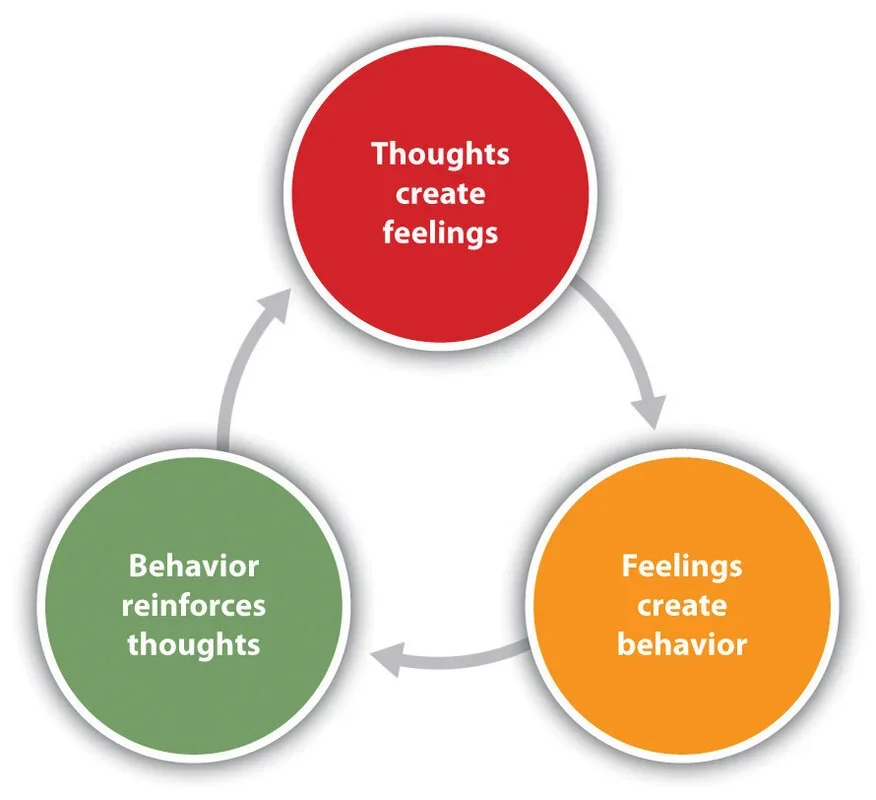
In Cognitive Behavioral Therapy, the therapist will help a client to identify how their thoughts, feelings, and behaviors are all connected. Image Credit: Cognitive Behavioral Therapy Los Angeles
When people find themselves in high stress or any mood change, there are undoubtedly some unhelpful thoughts that are floating around in their heads. Here you can find a list of common cognitive distortions.
In Cognitive Behavioral Therapy, the therapist will help a client to identify how their thoughts, feelings, and behaviors are all connected. I like to use this graphic with clients in order to help them see this visually; how each one impacts the other one.
What can be helpful about challenging these distorted thoughts is that they can stop a person from spiraling and feeling even worse. It is really hard to snap your fingers and change your mood and just “get over it;” it is much easier to challenge and reframe your thoughts in order to feel better.
Here’s an example of how you could identify, challenge, and reframe a thought:
“I noticed that my partner gave me a look when I walked in the door. Instead of greeting me like they usually do, they said a quick ‘hi’ and then continued to chop up some vegetables for dinner. They must be really upset with me. What did I do wrong?”
The cognitive distortion here is “mind reading,” or assuming what another person must be thinking or feeling. If this thought were to go unchallenged, I might spend a lot of energy trying to figure out what I did wrong, how I can make it right, and be hypervigilant to my partner’s behaviors. However, if I reframe this thought, I might have a better chance at feeling much more neutral to their quick “hi” when I walked into the door.
Here is an example of how I could reframe this:
“I know my partner said that they had a really busy day at work, and that sometimes they prefer to be quiet when they come home in order to transition themselves to home life. Maybe that is what is going on. If they are upset with me, they know that they can tell me and I trust them to do that.”
2) Titration: Stay Within Your Window of Tolerance
In the Somatic Experiencing world, we use a term called “titration” which is a fancy word for making sure that you are staying within your window of tolerance. The window of tolerance is the ability to be calm enough to tolerate some stress without being completely overwhelmed by it. It is the ability to be “regulated” without going into fight, flight, or freeze for too long.
Titration is the mechanism by which we stay here. So, what does it look like to try to have more titration throughout the day? Challenge yourself to pull back when the caregiving feels too challenging and you start to have thoughts like “I can’t do this anymore.” Can you walk into another room and take a few deep breaths? Could you request a more calming activity, like swinging in a hammock, with your child instead of the high intensity one they are wanting to engage in?
Curious about what this looks like in trauma therapy? Explore Somatic Therapy >
3) Ask for Help and Practice Boundaries (When to Say No)
This one, quite frankly, is rather boring and simple. Try to acknowledge when you are about to hit your limit and say no. Now, I know it is easy to say something like “well, that would be nice but I can’t just say ‘no’ whenever I feel like it. Nothing would get done.” Fair, but I want you to be a detective about finding the choices that you do have and exercising them as much as possible. Say no to the birthday party your kid got invited to whose parents you don’t even know. Say no to the PTA this year.
4) Community Support: The Protective Factor You Can’t Skip
Again, I know it is challenging to put energy into other people in order to find and create chemistry, but this one is non-negotiable. Having other people who you don’t have to perform for who just get you is important. Being able to rely on other people to help you out when things feel like they are too much is essential. Find your community and put energy there. It is one of the most rewarding things in the world. (If you are in search of community, here is a list of parent groups in the Kansas City area!)
When to Get Professional Support for Caregiver Burnout
If burnout symptoms like sleep disruption, anxiety or depressive symptoms, frequent illness, or feeling emotionally numb are persistent, trauma therapy can help you untangle stress patterns, strengthen boundaries, and build nervous system support.
Start Your Trauma Healing Journey With Somatic Therapy
At Embodied Healing KC, our trauma-informed therapists guide you with compassion and skill, helping you safely process emotions and build resilience. If you are ready to start healing from trauma and would like some support, reach out! Trauma-informed therapist Lauren Bradley has immediate openings and is ready to help you on your journey.
Frequently Asked Questions About Caregiver Burnout
-
Common caregiver burnout symptoms include emotional exhaustion, irritability, brain fog, sleep disruption, frequent headaches, and feeling detached or numb. If it feels like your capacity is shrinking over time, burnout may be present.
-
Burnout isn’t a diagnosis on its own, but it can overlap with anxiety, depression, and chronic stress. Support from a mental health professional can help clarify what’s happening and what kind of care would be most helpful.
-
Stress often feels like “too much,” while burnout can feel like “nothing left.” Burnout is more likely to include numbness, shutdown, or hopelessness, especially when stress has been ongoing without rest or support.
-
Start with micro-steps (2–5 minutes): longer exhales, stepping outside, or grounding through the senses. Small nervous system resets add up and can reduce caregiver stress over time.
-
Try naming the need clearly and specifically. Guilt is common, but support is a protective factor for both caregivers and the people they care for.
-
If you’re feeling stuck, resentful, numb, frequently ill, or overwhelmed most days, therapy can help you build coping tools, process grief, and strengthen boundaries.

Stevie Olson-Spiegel is a Licensed Therapist and Somatic Experiencing Practitioner located in Kansas City. She uses Somatic Experiencing as her main body-based trauma healing modality, as well as EMDR. As an Intuitive Eating Counselor, she uses these principles to help her clients challenge their relationship with their cultural misconceptions about their body and food.




Dr. Liz Roemer's mindfulness and acceptance-based approach to working with anxiety instead of against it, from a Kansas City therapist who specializes in anxiety treatment.